The Wurlitzer Sideman...
From the original Analog Industries archive. Some links and images from that era no longer resolve.
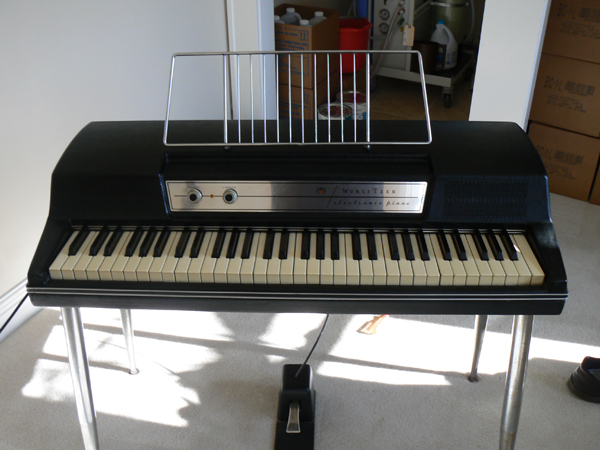
Now, I’ll grant that its usefulness is seriously outweighed by its historical significance (I don’t find myself often needing one Foxtrot beat, let alone two) but I ran across one of these today at Portland Music, and I simply couldn’t pass it up. $99 and a car ride later, the World’s First Drum Machine is sitting in my studio.
Of course, it is also worth mentioning that the Sideman is actually the World’s Second Drum Machine. The First title officially goes to the Chamberlin Model 100 Rhythmate, which came out in 1949. But the Chamberlin box was kind of like the Vikings discovering America first. When Columbus discovered it, it stayed discovered.
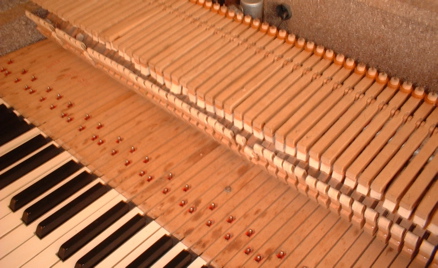
Here’s the Disk Of Rhythmic Doom, which is where the Beguine begins, if I may be so bold. It is actually quite crafty in its construction. The tempo is varied by physically moving the rubber wheel that drives this disk from the outer edge (slow) in towards the center (faster). The rhythm itself is selected by a monster rotary switch that has (I shit you not) 12 decks. The deck selected by the rotary switch determines which of the diverse instrument sounds (viz. Tom I, Temple Block II, Clave, et al) is allowed to escape during any particular tick of the contact wheel.
The other thing you’ll notice in the top picture are the momentary switches along the right side. These will shit out the appropriate drum sound on cue, should you desire to jam along with the Foxtrot. (Not as easy as it sounds, I’ve just discovered.)
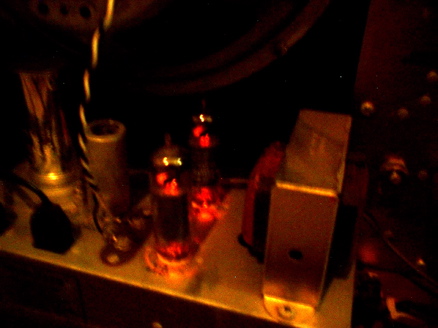
Here’s a pic of the amplifier, with its gently glowing compliment of t00bs. There are one 10” and two 3” speakers pooping out Foxtrots. This paritcular unit, which I nearly burst a disk getting out of my Jeep, works fine with the exception of a 120Hz hum, which means to me the filter cap in the tube amp needs to be replaced. The most interesting thing about it is that the “synth” section, for want of a better word, is mostly tube as well. There are 9 tube oscillators for making the various drum sounds in the synth section. There is a single shielded cable that goes from the synth to the amp, and it enters the amp via an RCA connector. This leads me to believe that I should have a relatively easy time sampling it without having to mic it up. We’ll see how that goes in a minute.
It needs some cosmetic work, as well, but it is in surprisingly good condition considering it is 47 years old. The simple fact that it works like a charm (other than the cap) speaks volumes to the craftsmanship of the people that made it. The brass lever contraption that controls the tempo alone is as complicated as any modern synthesizer. Electrical engineers didn’t design this thing. Normal engineers (the kind that make bridges and elevators) did.
**
UPDATE:** I’ve discovered, to my considerable dismay, that the hum originates in the synth section. It is a straight–up 60Hz mains hum, which means there’s a ground loop somewhere. That’s a drag; one look inside the “synth” part of the instrument sent me running outside, gasping for air. Since it’s all t00b, it is high-voltage city, with big fat 50s-era capacitors everywhere you look, holding (no doubt) lethal doses of DC just waiting for the brush of a finger to unload their Ninja-like powers of destruction. However, the hum is easily defeated with the excellent Waves X-Hum plug, so I can at least sample and use this box without having to perform surgery.
UPDATE 2: Since you are no doubt curious as to what this thing sounds like, I’ve made an MP3 of this bitch in action. I’m jamming (for want of a more better descriptor) on the Foxtrot section of things, which has quite a few variations, what with its multiple controls. I’ve just added Waves X-Hum to kill the 60-cycle noise, which is extreme. I experimented with X-Noise to get rid of the other buzzies, but I couldn’t come up with anything that really got rid of it and still let the “cymbals” through. Just know that the foot is missing some of its WHOMP. Make no mistake, this foot is the motherfucker of all kickdrums.
At the end of the MP3, I bypass the mechanical part (there’s a switch for that) and whack the individual instrument buttons a couple times each. You can, if you’re crafty, part out a Wurlitzer Sideman drum kit from this MP3, but with all the noise, I’d wait until I’ve gotten it worked on. I will most assuredly add the samples when I get good ones. That tube-based kick drum is to die for when you hear it moving air. As an aside, you’ll note that while the main rhythm is kicking, the feel is much less mechanical than a normal organ drum machine. This is ironically due to the inherent mechanical, rather than electronic, design of the machine; the rubber wheel that drives the rotary part slips, and what-not. Craziness.
Comments
Comments are closed on this post.