Algorithmism...
From the original Analog Industries archive. Some links and images from that era no longer resolve.
Longtime readers will note that I’ve often said that spring reverbs can’t be duplicated in software with existing technology. This subject came up in our most recent “What Should Audio Damage Make” thread. As a result of discussion that took place in that thread, Adam and Sean and I were having an e-mail go-round about spring reverbs. During the course of this, Adam pointed out to me that virtually anything can be expressed with a mathematical algorithm; the question is really whether we’re smart enough to come up with one.
Now, this didn’t change my opinion on spring reverbs in the slightest, and I’ve yet to hear an algorithmic spring worth a shit. But it did get me thinking about algorithms as they relate to music. I was pondering the fact that, given that I can synthesize a palette of sound broad enough to be the toolkit for a song using algorithms alone (where “palette” in this case can be used to mean both sounds and effects), and given that I’m able to sequence those sounds in to an interesting and meaningful pattern using more algorithms, one could take all this combined nonsense together, and theoretically create an algorithm that could, given a set of initial conditions, poop out an entire piece of music on its own that was fairly pleasant to listen to.
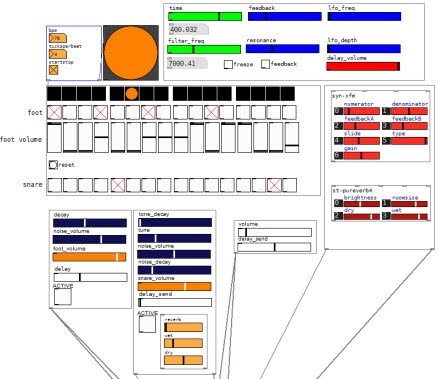
While this was an interesting hypothesis on my part (at least to me, anyhow) I thought that it could stand some experimentation. So I set out to create an entire Pd abstract where one could set a state, press “go,” and sit back and listen to a nice piece of music. I’ve been at it for several days now, and I’ve got a drum beat and a bassline occurring. So I’m a long, long way from proving my hypothesis.
But, for what it’s worth, I’m fairly certain it’s possible. Autechre did this quite a bit in Confield and a couple other releases, but it was mostly sample firing and MIDI output. My attempt is entirely procedural, pure code. No samples or MIDI at all; it will be completely synthesized on the fly in Pd, and all the effects done in real-time.
Anyhow, all personal windmills aside, the real point of this post is to propose the following: modern song-writing environments, mainly Live and to a certain extent Garageband and the various looperific tools in the top-line DAWs, have created a situation where the song itself is an instrument. When you grab a pile of loops and put them in the clip view of Live and put them in meaningful groups and what-not, you are not so much using Live as an instrument as you’re using fairly large chunks of sound as the instrument, and Live is merely a facilitator (in the same fashion that a guitar amp is the facilitator of the guitar.)
Of course, you can certainly synthesize and record within Live or whatever DAW. I’m referring strictly to the practice of creating songs from samples. Am I horribly misguided in this theory?
Comments
Comments are closed on this post.