Monotribe Mini-Review...
From the original Analog Industries archive. Some links and images from that era no longer resolve.
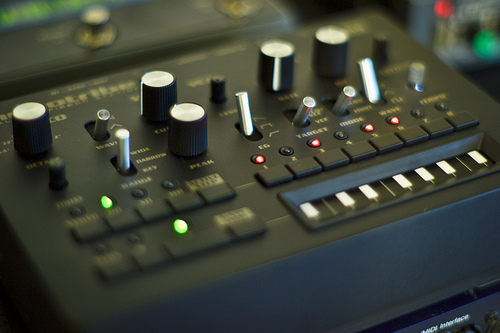
Last night my BFF The UPS Guy dropped off a shiny new Monotribe. I really haven’t had time to put it through its paces, so I’ll pre mea culpa this review in to submission by saying that once I’ve attempted to use it in a song, I’ll almost certainly have different views. If you’re reading this via a Google search and it’s more than about a month old, chances are good there’s another review later in the timeline.
With that out of the way, some thoughts:
1. It is much larger than I thought it would be. It is bigger than a TETR4 / Mopho. About the same footprint, but it is quite a bit taller. It is also heavier. It ships with 6 AA batteries, but it doesn’t come with a wall wart. Korg, being Korg, didn’t give it a standard 9V power hole, so you can’t power it with one of the 30-odd 9V bricks you already have. Thanks for that, Korg. Good lookin’ out.
2. Construction-quality-wise, it is far sturdier than the Monotron. It is fairly chunky. The pots have some wiggle to them, but I imagine this is made with the cheapest possible components, and if the Monotron is any indicator, we’re lucky to get knobs at all. In fact, four of the controls are the same as the little pot shaft things on the Monotron, while five of them (the more often-used ones) are of a more substantial construction.
3. The sequencer is very crafty in its operation. However, the 8 step thing is really truly annoying. And note that the unit runs at 1/8th note steps. It’s kind of normal to think of 8 steps as half of a measure, but as far as this is concerned, it runs at 1/8th notes for a whole measure.
4. There is an iOS app (here) which allows you to send sync to the Monotribe, using a number of different methods. You could, for instance, be running iElectribe on your iPad via MIDI sync, and sync to the Monotribe app via a WIST session. You’d be best served by having several iDevices to pull off this tomfoolery. Also, when driven by the app, the Monotribe switches to a 1/16th note timebase of a half measure, sort of. (The opposite of point #3, above, but you can really only program 8th notes, still. So you get four.) You can also hit the sync control with a 5V voltage spike (or dip, selectable) so if you have a modular or a DC-coupled audio interface, you can sync the Monotribe’s sequencer that way.
EDIT: The drum machine is 16 steps, and can save one pattern. I have verified this. See comments. The synth is 8 steps only, though.
5. The synth voice sounds like an MS10 to me. Taken in concert with the LFO, it is a fairly capable voice, much broader in ability than the Monotron. The filter is even a little bit screamier. The drum voices sound like they came from an SR-120. Not “phatt” by any means.
6. I couldn’t find any mods with a cursory Google search. I’m sure they’ll be along shortly, though.
Anyhow, that’s the general idea. I’ll use it in my next Experiment video, so you can hear it in context. There are a couple dozen demo videos on YouTube already, so you can get a good idea of its operation. I bought it here for $229. If you have any specific questions I’ll be happy to answer them to the best of my abilities.
Comments
Comments are closed on this post.