Tempest First Impressions...
From the original Analog Industries archive. Some links and images from that era no longer resolve.
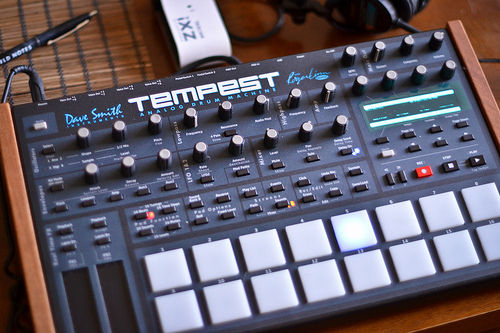
DSI were kind enough to loan me one of the first production versions of the upcoming Tempest drum machine for beta testing and to write some presets. The word “loan” there is loaded, because they’re gonna have to send heavily armed gear ninjas to my house to get it back. To describe this thing as bad ass is to understate the matter entirely.
There are plenty of articles out there on what the Tempest is, and a simple Google search will give you the full technical run-down, so I won’t bother with that. Long story short, if you’re familiar with the Mopho/TETR4/P’08, this is obviously designed by the same folks, and has the same general vibe.
The oscillators are one of the two places where the Tempest really departs from the normal DSI analog voice architecture. Each of the six voices has two analog oscillators and two digital ones; all four can blow at once. The digital oscillators comprise several methods of making noise (they did a very good job in the noise selection department), a couple hundred different drum samples running the gamut of styles, and the complete Prophet VS waveform library. They are quite capable, and while being necessarily drum-centric, Tempest can also do a pretty favorable turn as a synth.
The other place the Tempest differs from normal DSI gear is in the envelopes. There are five in all. Three are hard-wired to pitch, LPF, and VCA respectively, and two are not pre-assigned. These envelopes can be ADSR (synth-like) or AD (drum-like), and they are very fast and accurate. These are some of the best envelopes I have come across, period, and I might have a little experience with synth programming. I’m going to strongly lobby that DSI put them in all their products from here on out, and that other synth manufacturers license the design. Another pure win aspect: the envelopes can mod themselves via the excellent mod routing page. What this means is that DSI doesn’t have to have a bunch of extra controls for envelope shapes. You can just hit an envelope with its own output to change the response curve. Extremely simple once you get the knack of it, and it extends the sound palette considerably.
The timing and feel of the unit is rock solid. No offense to Elektron, but they need to send someone to DSI to learn how this is done. I recorded several passes and got in to single sample viewing range trying to find diversion, but there is none. “Spot on” doesn’t begin to describe it. The feel of the sequencer is subjective, I’ll grant, and is a function of the timing, the swing, and the velocity response curve, and how they interface with your worldview. The swing in this unit is lifted directly from the LinnDrum via the MPC60, and feels exactly right, as it should. Roger Linn knows swing, and this unit reflects that.
Several people have asked me on Twitter about its sampling capabilities, and suffice it to say that there are none. It is a drum synthesizer with some sample ROM, not a sampler at all. There is no audio input on the unit, period.
Anyhow, long story short, this is my dream drum machine, and I’m turning my house in to a bunker to fight off Dave Smith and his Ninja Army. I’ll be happy to field any questions anyone might have, within the confines of what I’ve been given permission to talk about. (Keep in mind that despite being a production unit hardware-wise, this still has beta software, and I can’t talk about features that haven’t been implemented, or that are experiencing a state of flux.)
Comments
Comments are closed on this post.