Effecting, Affecting...
From the original Analog Industries archive. Some links and images from that era no longer resolve.
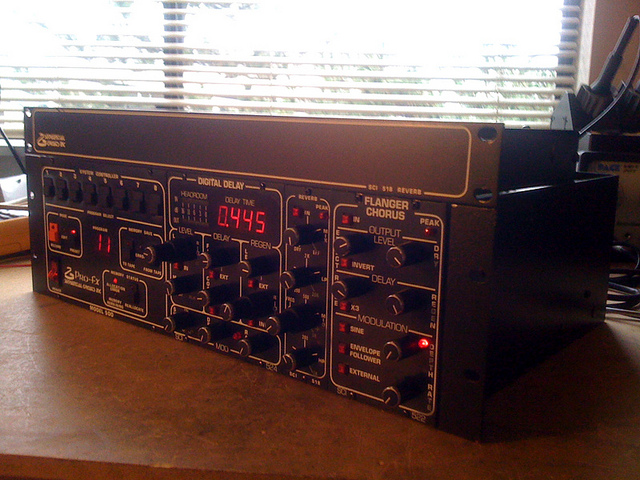
In the interests of moving along from the remarkably tedious discussion of insurance in the previous post, I’m forced to essentially manufacture a topic. Luckily, this is within my blogging skill-set, and you’re welcome, at this point, to admire the deft hand I apply to the task.
The picture above is of one of my unicorns, the Sequential Circuits Pro-FX (ambient version). It is for sale currently. It seems that whenever I have coin lying about to blow on stupid shit I don’t need, I can never find one of these. But when I don’t, lo and behold, there they are. Now, anyone with a reasonable purchase on, you know, reality and stuff, would say “hey, Chris, that’s a mediocre pair of digital delays and a small spring reverb. Do you seriously think spending CDN$1600 on that is a good idea when you can easily replicate that with commonly available vintage effects?”
No. No, I don’t. But a unicorn is a unicorn, and there you have it.
The larger point, though: I have long been of the firm opinion that any sound can be made in to any other sound with the cunning use of effects, if you know the mechanics behind what is occurring. You don’t need a comprehensive understanding of the physics of sound, but rather a fairly modest knowledge of why, say, a kick drum works. For instance, you recall my posts a couple weeks ago about the instruments I’ve been welding. Here is a short excerpt from the drum part for a track I’m working on.
Every single sound you hear in this track started from SpringThing, recorded with the Barcus-Berry transducer mic. I basically have every guitar pedal I own slapped on the output of the transducer, and am merrily using everything available to me in Maschine once I’ve recorded one-shots, then stacking a whole raft of Audio Damage plug-ins on the outputs of Maschine. The point being that if you look at the instrument I started with, and listen to the result, there is no apparent way the latter could have come from the former; the one possible exception is the “ride cymbal” sound, which is obviously a Biro pen hitting a stretched spring, through a high-pass filter and a grain delay. Isn’t it?
My question is thus: is this “cheating?” Are you all about the purity of the recorded sound? Or do you break out the carving knives?
Comments
Comments are closed on this post.