Cut Me Off A Line Of That, Please...
From the original Analog Industries archive. Some links and images from that era no longer resolve.
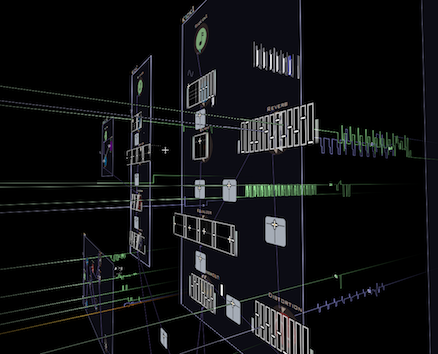
It looks like Jonathan Heppner, the creator of AudioGL, has finally made a beta available; $80 for a full license, and there’s a save-disabled version to try out, if you want to give it a whirl. (32-bit Win only, requires a pretty robust PC with OpenGL 2.0 support.) Worked fine on my system. I took that screenshot myself, but it’s worth noting that my PC is so blown-out overpowered that I’m not a terribly good test case for such things. Don’t let the look of it scare you; at its base level, it is more-or-less a boxes-and-wires synthesizer that we’re all familiar with, that happens to have a very sophisticated sequencer, and you can, if you so desire, look at things in a perspective mode for some visual interest. No plug-in support, as yet. Peter Kirn did a full write-up with all the deets at CDM, so I won’t bore you with the technicalities.
What I really want to talk about is how this shoehorns in to my latest flight of fancy. What I like about this app is that Jonathan has, for the most part, ignored the standard conventions that the music tech industry relies on. (COMMANDMENT ONE: THALL SHALT MAKE ALL COMPRESSORS LOOK LIKE A BEAT-UP 1176! ETC.) Instead, he’s just made it look cool and logical.
There are two opposing points of view to this methodology. For those against it, the general vibe seems to be that music software should look like the music hardware it clones, because the interface is familiar, and musicians are stupid and can’t be bothered to figure out even the most simple departures from this method. The second, and the one I personally follow, needs some explanation.
I find it ironic that musicians are so conservative in their use of technology, when their lifestyle choices are anything but. Of the 10 most popular DAWs, 8 follow the “tape deck and mixing console” paradigm, even though the vast majority of the people that use those DAWs have never set foot in a commercial recording facility, nor have they seen an analog multi-track tape machine in real life. Ask a guitar player what his pinnacle rig is, and dollars to donuts he won’t say a Parker Fly Artist and a Kemper Modeling Amp (which is a demonstrably high-quality, playable, great-sounding, versatile combination.) He’ll say a ’57 Strat (sigh) and a vintage Marshall Plexi (deep, shuddering sigh.) Want to see an electronic musician jump around like a monkey on coke? Put him in the same room with a MemoryMoog, ARP 2600, or Prophet 5. Recording engineers? Fairchild, Neve. Fairchild, Neve. Fairchild, Neve. EMT! kktnxbai.
Of course, those things are all popular wishes because they sound “good,” for various values of good. Although I’ve heard plenty of shitty records recorded on Neve consoles to analog tape, that have MemoryMoogs and Strat/Plexi guitars tracked through Fairchild comps, with EMT plate reverb. There are, no doubt, tens of thousands of suck-ass records that use those very pieces of gear.
My opinion on the matter is that when you are first presented with a piece of software, if that software’s user interface follows some real-world gear, you concentrate on the things it can’t do, or the reasons it doesn’t sound like the “real thing.” If, on the other hand, it is unique to the software, you spend your time figuring out what it can do, while you learn how to use it. Sure, the learning curve is a bit steeper; the only thing you have to figure out on an 1176 plug-in clone is how the developers implemented the “all buttons in” mode. But look at it this way: one day, way back in the mists of time, some engineer opened a box and in it was a brand new 1176, a product he’d never seen before, and didn’t know how to use. He put it in his rack, and some time later he just, for the fuck of it, decided to see what it sounded like when he pushed in all four ratio buttons.
Nobody has made that discovery with an 1176 plug-in.
Comments
Comments are closed on this post.