Analog Four...
From the original Analog Industries archive. Some links and images from that era no longer resolve.
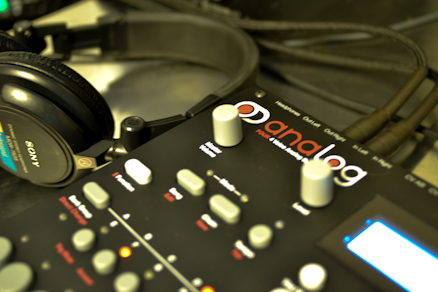
After several days of slogging around NAMM, and experiencing so many product demos they kind of turned in to a blur of specs, connectors, and knob labels (“SAY iOS AGAIN, MOTHERFUCKER!!!”), when all was said and done there were only two pieces of gear I really wanted. The Prophet 12 and this lil’ feller, the Elektron Analog Four. Since the Prophet 12 is made of unobtanium (unless you’re Trent Reznor, which I apparently am not) I had to throw money at Sweden when I got home. UPS dropped off a shiny new Analog Four yesterday, and away we go.
I’ve owned every single piece of Elektron gear except the Octatrack at one time or another, and this unit is a logical progression of the general Elektron design philosophy and UI methodology. As such, thinking of it as a synth isn’t really the right tactic. I mean, you can load up a sound, and play it with MIDI, like any other synth. But it is really a synth/sequencer combination, in that without using its own sequencer, you’re not getting the full experience. (In much the same vein as a 303, honestly.) The synth topology is designed to take advantage of the internal sequencer, and sounds kind of funky without it.
After playing around a bit, I hooked it up to Live to try making a track. This engendered the usual raft of problems with syncing Elektron gear. Took me an hour or so of fooling about before I remembered that Live 8 and 9 have an adjustment in the MIDI setup panel to time-compensate MIDI clock. In order to get the correct timing differential (which is a result of several factors, including the latency of the audio I/O) I recorded a couple measures of the metronome in the Analog Four, time-corrected them in Live so that they were exactly on the beat, then adjusted the MIDI clock delay value until the recorded metronome and the one coming from the A4 were flanging. For me, this was -40.5ms, but your mileage may vary. In hosts that don’t have this clock compensation method, you’ll have to delay all the non-A4 tracks by the appropriate amount.
It doesn’t seem to have the timing drift and end-of-cycle hiccups that plagued the MachineDrum and MonoMachine (at least when I had them); once I compensated for the clock offset, it is rock solid, timing-wise. I recorded 64 measures of a 16th note white noise tick just to make sure, and a visual check showed every beat was perfectly in time.
In use, it is somewhat easier to program than the MonoMachine. I usually had to resort to programming the MM with an external MIDI controller, as entering note values was quite tedious. The Analog Four includes a 1-octave keyboard on the front panel, and you can either use this to program note values of existing steps, set the note value of steps you’re manually entering, or play the selected synth voice live directly. This makes a HUGE difference in ease of use, honestly. I wouldn’t have thought such a small addition would do so, but I would have been wrong.
The sequencer, by and large, is identical to the sequencers in the other Elektron products. They’ve added a “Performance Controls” section, which is per-kit and can be used for macro control of all sounds, so you don’t have to go menu diving during live performance. This is a very nice addition for live use, I imagine, although I don’t do hardly any of that any more.
The synth is intriguing. They somehow managed to bring their sound design philosophy to a nearly entirely analog environment, which is quite a trick considering how digital their previous products are. Even though it is very obviously an analog synth, it still sounds entirely Elektron. As to whether this is your cup of tea is a subjective opinion. I like the topology quite a bit. The only real minus is that each mod source only has two destinations. This necessarily limits the complexity of the sounds. But it still sounds unique, which is the important thing. Most of the true analog synths that have come out in the last couple years are virtually identical in their topology, differing only in the filter design. This unit doesn’t have that problem.
Overall, I like it, and I think it is well worth the money. You’re essentially getting four independent analog synths, an effects engine, a sophisticated live performance sequencer, and a full CV/gate control brain for a small modular, all in one convenient package. Figure each synth costs $275 (which is, it must be said, a steal for such a sophisticated and unique analog voice) and all the rest of the stuff is a bonus.
Now, it won’t just drop in to your rig like any other synth. It is its own environment, and has a much steeper learning curve than a typical 2-osc analog. It also sounds very Elektron, and the results you’re going to get are going to rapidly taper to a particular sound and vibe that is heavily informed by the sequencer. But that said, it is sophisticated, powerful, and sounds good. My only real complaint is that there aren’t individual outs for the voices; it only has stereo outs. This can be dealt with, but it is obviously easier to have multi outs in a modern production environment.
My recommendation is Buy It Now, at the end of the day. If you have any specific questions, I’ll be happy to attempt to answer them.
Comments
Comments are closed on this post.