Two Steps Forward...
From the original Analog Industries archive. Some links and images from that era no longer resolve.
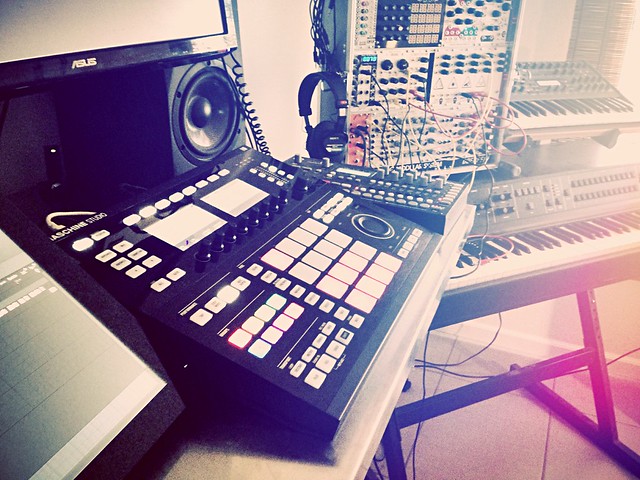
I got a Maschine Studio last week, and let’s just state right now that it’s a pretty nice piece of kit. In a nutshell, they’ve taken the original Maschine controller and broken out all the shift buttons to direct control, and added a jog wheel and a pair of whopping big hi-res color displays.
There are plenty of reviews out on the Interwebs, by people that specialize in that sort of thing, so I won’t bother going over all the differences between the Maschine 2.0 software and its predecessor, or all the fine points of the new controller. Rather, I’ll just toss off some comments that have come to mind in the last week as I’ve used it, and answer some of the obvious questions.
1. Not A DAW. There was a bit of a hope among a certain type of person (myself included) that the Maschine 2.0 software would turn it in to a full production environment, but let’s make one thing clear: this software has its roots in MPC-oriented programming, and it hasn’t strayed from that path. In order to function as a DAW, the software must operate in a non-linear way, and Maschine 2.0 is about as linear as it gets. The ability to chain Scenes to make a song is identical to the one in Maschine 1.x, and that hasn’t been added to at all. Without a more advanced, less linear method of chaining patterns, this device and its software are still very much a sampling drum machine.
2. Renderless, So Render Less. The audio export function will only export the current scene. There is no method in which to render a song chain. If you’re using it in stand-alone mode, the only way to record your performance is with an analog loopback or a separate recording device. One person’s advice was “render the scenes, then put them together in your DAW.” That’s an awful idea for so many obvious reasons I won’t go in to it. My solution, such as it is, is to build the song’s parts in stand-alone, then instance Maschine inside Live, and use a Resampling track to record the performance.
EDIT: The above is not entirely correct. The “Export Audio” function exports the loop range, whatever that is. So if you’ve extended the loop range to encompass several scenes, then that’s what gets exported. My mistake.
3. No Studio Required. As I said, the Studio controller is essentially the earlier controller with all the shift buttons broken out. I don’t personally see the need for the jog wheel, which only duplicates functionality that is occurring where your hand already was. I could have thought of many better things to put in that spot, but they didn’t ask me. The jog wheel is basically superfluous, for all intents and purposes. The displays make browsing for sounds and plug-ins and effects from Komplete very nice. However, if you’re using your own library and 3rd party plugs, then you don’t see them at their best. So you can live without it. In short, the Maschine Studio controller isn’t strictly necessary; it won’t limit your ability to control Maschine 2.0 at all, best I can tell. That said, it is a very nice controller, and is extremely well-built. It occupies a much larger footprint than the originals; it is, in surface area, roughly twice as big. However, the pads themselves, where the rubber meets the road, are identical to those in Maschine Mk 2.
4. Synthesize! The built-in drum synths are honestly a bit amazing. I don’t know how they did some of them, and I am pretty well-versed in drum synthesis; I assume they’re mostly a combination of physical modeling, traditional synthesis, and minor sample playback. You get a variety of starting points for each of the traditional drum voices, with 5 to 8 controls for the voice. In many cases (especially the snares) the result is indistinguishable from a sample. I wish these were a bit more out-there, but no complaints. I can always instance a synth to get what I need.
In any event, my feelings are thus: the Maschine 2.0 software is a must-upgrade. No joke, it is head and shoulders above the first iteration. As far as the Maschine Studio goes, it is extremely nice; if you already have a Mk 2, you probably can live without it, but why on Earth would you want to?
(Obligatory Caveat: I did not pay for the Maschine Studio; I received it as an NFR.)
Comments
Comments are closed on this post.