De-Shitifying Life
This is a long story, and perhaps uninteresting unless you find workflow to be a fascinating subject. With that proviso, here we go… The day Tim Apple gave Mango Mussolini a golden participation trophy to fend off any future tantrums was the day I took a good hard look at my life, and began the process of weaning myself from these Silicon Valley fucknuts. Obviously, my job revolves around tech, but I had been a fairly passive consumer to that point. New MacBook Pro every three years, new iPhone every two years, new iPad every year. Fully update the Windows machine three times a decade. Basically ignore Linux as much as I can. Pay my Creative Cloud subscription. Suffer the minor annoyances of dealing with all that in silence. The act of wondering out loud if I actually needed all this shit turned out to be the beginning of a sort of quest. Interestingly, Silicon Valley was an unwitting accomplice to this process, once I knew what I was looking for.
The biggest roadblock, as I perceived it, to reducing my reliance on Increasing Shareholder Value for others was Creative Cloud. This is the case for most people on the creative side of tech businesses, I imagine. I’ve been paying for Creative Cloud since it existed and initially I thought it was a pretty good value, but when I started to add it up, I could have bought a car or a really nice PPG Wave 2.3 or paid off a big chunk of my mortgage. And that started to annoy me. In thinking about it, while I had most of the CC apps installed, to do the media creation portion of my job, all I really needed was Photoshop, Illustrator, and Premiere. I personally used Lightroom quite a bit, but that wasn’t part of this equation. That didn’t initially seem insurmountable, but it took the most time to get out of that hole. I’m not going to use GIMP or Inkscape, because sorry but just no. Obviously, I don’t mind paying, given what I paid for CC. As luck would have it, literally while I was searching and demoing, Canva purchased Affinity and released Affinity Studio for free. I wasn’t familiar with it, but it seemed to hit all the bullet points: integrated vector and pixel drawing, and cross-platform. It took me a couple weeks to retune my muscle memory, but it was and is capable enough for my Audio Damage work, and that’s all I was asking. Premiere, well, that was simple to replace. DaVinci Resolve is easily as good as Premiere, at least for my needs. More capable in some respects, particularly in audio, where the built-in Fairlight DAW absolutely smokes the audio “features” of Premiere. And it’s free! So, with Affinity Studio and Resolve (and TouchDesigner for motion graphics), Creative Cloud was replaced. Later, ’Tater.
The MacBook Pro situation took some more research. I was thinking that the vast majority of the time, my MBP is just docked, and not actually being carted around. And literally in the middle of this process I went to NYC and broke the screen during the transfer from Penn Station to my hotel. $800+ for Apple to replace it, or $400+ for me to buy a second-hand lid assembly and replace it myself. Or it could just go on the stack of broken MacBooks Pro and I could buy another one.
Or…
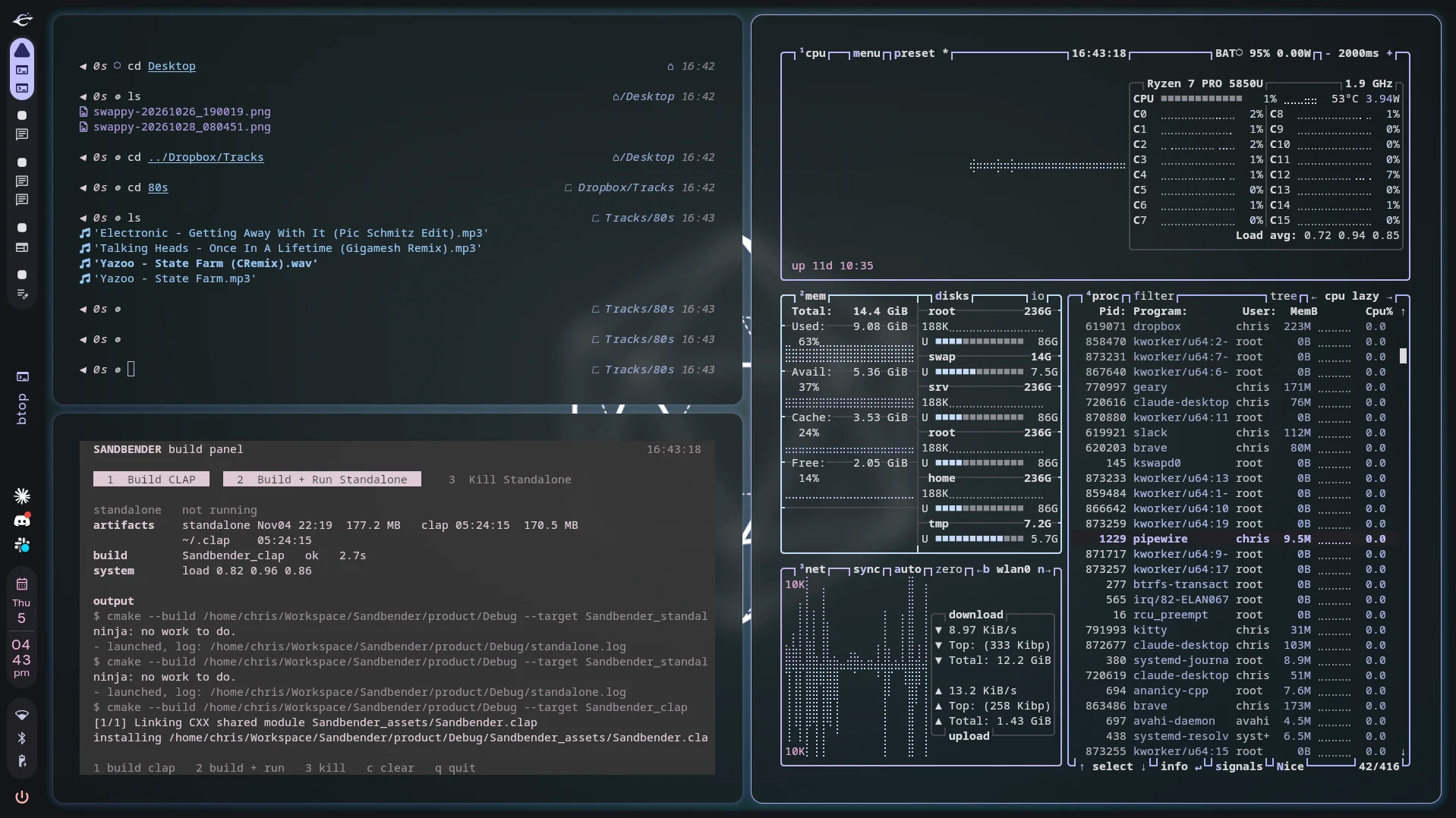
The M4 Mac mini was far more capable than my M1 MBP, and significantly cheaper than a new MBP. Could I go fully no-laptop? I like working on the couch or in the back yard, but I decided to try and see if I could just iPad things. Turns out, not really. The iPad is kind of shit for actual work, in a number of ways. However, I happened to get a Short in my YouTube feed showing how someone put CachyOS on a ThinkPad T14s. I had been pondering switching to Linux for my daily driver anyhow; I can remote in to any of the other machines and use whichever one is appropriate for a given task, and most of my day is spent in terminal windows and Bitwig, which look the same on any machine. So, I found a reputable refurb shop on eBay and got myself a refurbed T14s with a Ryzen 7 CPU, 16GB of RAM, and a touchscreen (no drive) for $280. There are a quadratic fuckton of these things on the market as they’re used in enterprise. I stuck a 1TB NVMe drive in it and blew in CachyOS. On top of that, I installed the Caelestia shell, which is basically a skin on Hyprland. No particular reason except that it looks dope and makes me happy.
It took a couple days to get it set up and learn all the Caelestia key combinations, but I have to say that this is really one of the best OS/laptop combos I’ve used. The ROI is ludicrous, considering it cost less than US$300. It is now my principal machine for all things Audio Damage, and whenever I’m using one of the other computers, I end up getting frustrated that all the keyboard commands don’t work. Both Adam and I have moved to a Linux-first build process for Audio Damage stuff since I did this. I have a desktop CachyOS/Caelestia machine with 64GB of RAM for sit-down-and-concentrate full metal dev work, and I have also installed it on an otherwise useless 2012 MacBook Pro for my home entertainment system, and a different Arch flavor on a Gigabyte NUC to use as a SteamBox for my living room. Arch Linux in general, and CachyOS in particular, is very good at making old machines useful again.
Which brings us up to the present day. I’ve been using this new workflow for a couple months now, and it has made me really look at the other ways I can simply remove those Bay Area assclowns from my life. I’m no neckbeard; I don’t have any desire to sit around and bikeshed Linux distros. I have work to do. But I’ve convinced myself that, for now anyhow, I have finally managed to start getting off the Subscription & Incrementalism Treadmill that Silicon Valley is constantly foisting on us. I’m using the M4 Mac mini for music still, and I need to keep a rolling upgrade of iOS products for work; that’s unavoidable. But progress is progress.
Comments