Total Kaoss...
From the original Analog Industries archive. Some links and images from that era no longer resolve.
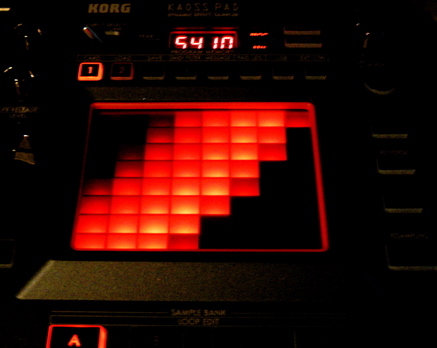
It was requested that I provide a review of the Korg Kaoss Pad 3 I just received. Since there are about 300 proper reviews on the Interwebs that go in to some detail about the various aspects of the machine, I’ll limit this to subjective opinions based upon a few days of use. So, in no particular order…
1. I/O: The I/O on this machine is a joke. Just stereo RCA on the back, and a quarter-inch jack on the front that is ostensibly a “mic” input with a trim knob. This may be fine for a weekend warrior/DJ/whatever, but for a professional user, it’s annoying in the extreme. Why on earth would I even own unbalanced RCA to balanced XLR or TRS cables? I wouldn’t, because they’re stupid. At least put 1/4” on there, so we can use normal TRS cables in a pinch, rather than building some adaptor contraption. Or SPDIF? Christ. This is, by far, the most annoying aspect of the machine, and was very nearly a deal breaker for me.
2. Delay Modulation: This is another fairly annoying “feature”. There is a delay that is always on, who’s volume is controlled by the large slider on the left of the unit. The purpose of this delay is to ease the transition between “on” and “off” so you can play the effect or whatever. Not a bad idea in theory. However, the delay in question has some ridiculous modulation on it that kicks in after about the third repeat that sounds like a warped record. This is gay. Many of the real delay patches (all but two, actually) also have silly modulation in the tail, for what purpose I don’t know. Whoever thought that was a good idea needs to have their head examined. Since you can’t edit any of the patches, you can’t take it out.
3. Aliasing: most all of the clean patches have digital aliasing noise. When there is any modulation at all, there is also zipper noise. This isn’t so obvious when you’re rockin’, but if your stock in trade is nice clean, sparse music, you’re gonna hear it for sure. It sounds very “digital” as a result. Don’t come here if you’re looking for any sort of “analog” sound (the word “phat” comes to mind, even though it’s not a word) because there ain’t none.
4. The User Interface: now we get in to something I actually like. The interface is incredibly well-laid-out. You’re only two button presses from _anything_, which is nice for a live context. Since they used an LED display instead of an LCD, it isn’t always obvious what the patches are about, so there’s a bit of a learning curve. The X/Y pad actually displays the full patch names, but it takes a while for the whole thing to go by.
5. MIDI: The MIDI features are comprehensive, both sending and receiving. You can play the sampler/looper engine via MIDI, which is nice, or record X/Y pad moves in your sequencer. All fine.
6. Sampling/Looping: The implimentation of the sampling engine is kind of odd. I’m having a hard time getting loops to record without modulation in them, which is weird. Also, the A/D or D/A really sounds like ass on a platter, so what goes in and what comes out have no resemblance to one another. The most annoying feature is that if you play a bit of a loop, when you restart that loop, it starts at where you stopped it, not at the beginning. I’m sure there’s some thought behind that, but I can’t for the life of me see the reasoning.
In conclusion, for a $400 multi-effect, this is probably the worst deal on the planet. If you’re looking at this to add to your effect arsenal, I might direct you to about 67 other devices that cost less and do more. For a live performance device, especially if you do some of the harder electronic styles, this unit is the business. I almost want to book a Micronaut show just to use it on stage. (Almost, but not really at all, actually.) As I said, these are subjective opinions. My love/hate thing I have going with this box is in its infancy.
Comments
Comments are closed on this post.