It Don't Get Much More Vintage Than This...
From the original Analog Industries archive. Some links and images from that era no longer resolve.
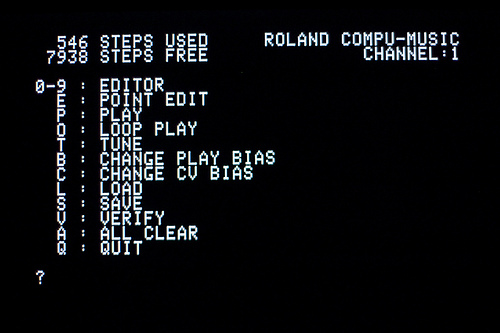
This is the main screen of the Roland Compu-Music software that drives the CMU-800R. As you can see, liberally sprinkling the word “bias” about makes it seem fairly pro. The point of the CMU-800R itself is to give the user an 8-channel CV-based sequencer that runs in a computer. The audio that comes out of the unit is most assuredly an afterthought, and there is no mention of the sounds themselves in the software other than the drum voices on the beat programming page.
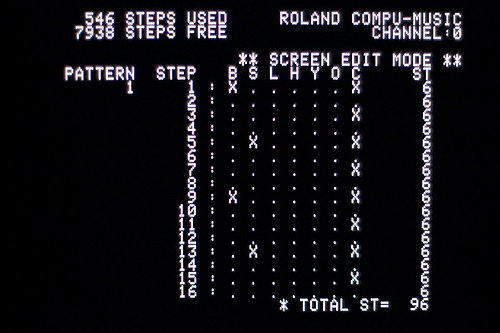
This is the page where you make a drum beat. It (unlike the note entry screens) is actually really easy to use. As you can see, it is vertical rather than horizontal, but otherwise is a standard Roland drum grid. The voices, left to right, are foot, snare, low tom, hi tom, cymbal, open hat, closed hat. You just cursor around, laying down an X every time you want a hit. You control the timing on the right side in the ST column. The CMU-800 software, like most music software of the era, runs on a 24PPQ time base, so that “6” you see running down the side equates to 16th notes. Pretty easy to add swing to specific notes or whatever. If I wanted what would equate to about a 56% swing in today’s sequencers, I’d just alternate the numbers 7, 5, 7, 5, and so on. Don’t want a step to play? Slap a zero in that bitch. Easy peasy.
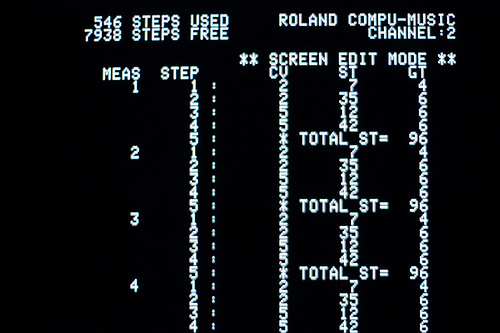
This is the note entry screen. Never having used a tracker before, I’ll admit I was somewhat flumoxed by it for a while. I had to crack the manual (the shame and horror) and experiment for a bit, but I got it eventually. The “CV” column is the note number, 0-127, where 0 corresponds to the C four octaves below middle C. The ST is “Step time,” or how many pulses until the next note fires. (Remember, we’re operating on PPQ here.) The GT column is “Gate Time,” how long the gate is open in this step. I’ve given this pattern (a bassline) a touch of swing, so it’s kind of a trick to see wtf is going on, but stare at it long enough and it’ll either make sense or not.
I won’t bother going in to the details of how to make a pattern, since the usefulness of this information is limited to, well, me and like two other dudes. But it’s kind of interesting to draw parallels between this c. 1981 tech and what we do today. It took me about an hour to get a few patterns in for the backing tracks of an existing song. If I had to actually write music on this? My paradigm done shifted away from that a long time ago. Don’t know if I could do it, honestly.
Comments
Comments are closed on this post.