ZOMG! IT'S MONDAY! WTF?
From the original Analog Industries archive. Some links and images from that era no longer resolve.
I spent the weekend working out which songs from the rather extensive Micronaut oeuvre I’m going to build a set with, and arranging and stemming same. Part of the problem with the Micronaut catalog is that most of the material (except for the first record and the most recent three releases) was done with a specific purpose, generally a video game or television show. As such, the vast majority are quite dated, stylistically, and don’t really work in a modern performance context.
I’ve been steadily modernizing some of the older tracks for inclusion in the Many Moons compendium release, so I’ve got the ones I’ve already done to draw upon, conveniently. Even so, the set will be centered around newer material from Capacitor and Resistor, though, plus at least two tracks from the upcoming Transformer. The nice thing about the nature of Micronaut’s past is that I don’t have to play a selection of “hits.” That’s what really made SMG not a lot of fun towards the end, as we were trying to play new songs we’re quite proud of, and people kept yelling “SINS!” or “HOLE IN THE GROUND!” the whole set. Not a problem with Micronaut.
But anyhow, with such a large catalog to choose from (there are over a hundred published Micronaut tracks) it’s just a matter of finding the right flow. I like themed sets; one of the hardest SMG sets to pull off was the last tour we did, where we did the entire set in reverse chronological order; that was an interesting challenge. With this Micronaut set, I’m doing two tempo builds, which is something that I’ve seen other electronic acts do (notably Underworld, who commonly use this mechanism) to good effect. I also, in this case, have to pay attention to the harmonic relationship between the keys of songs, so they can overlap if I feel the urge.
Do you find, when designing a set, that you do stylistic groupings like this? Or do you do it for mechanical ease? I suppose it really depends on the kind of music you make. Much easier for an indie rock band to change things up on a whim than a strictly electronic project, I imagine.
21 comments
@speak_onion: I mainly meant setlist, but if the band is well-rehearsed and knows the songs, it's pretty easy to change shit up on the fly. Key, tempo, arrangement, individual parts: all are much more maleable than a stemmed electronic show.
Of course, well-rehearsed indie rock bands that know their own songs are not terribly common, I'll grant.
-CR
@Boobs,
Live only encourages spontaneity when you become a relatively advanced used IMO. Most intermediate users in my experience use live to handily trigger their backing tracks, or stems. Above that, live makes it easy to turn fx on and off, which people have been able to do with ease since stompboxes. When you do learn the ins and outs of live, it can be a very powerful tool of spontaneity. It can even generate whole songs from a few basic elements and some clever programming, which some might consider the peak of spontaneity.
First show i ever went to was a Fugazi show at a local school. I was 15...
Nothing since has quite rocked as hard
Having your first show be a Fugazi show will kind of ruin you for anything else. Except, perhaps, Killing Joke or Agent Orange or something.
My first "real" concert (as opposed to church bullshit or school bullshit) was The Cars, on the Heartbeat City tour. Wang Chung opened. That ruined me for oscillator sync for the rest of my natural life.
-CR
I'm with boobs.
I'm with boobs.
"Do you find, when designing a set, that you do stylistic groupings like this? Or do you do it for mechanical ease? I suppose it really depends on the kind of music you make."
I guess it depends on the type of set I am doing... for club sets, I usually build it by tempo (start around 80bpm and work my way to 200bpm by the end). In doing so I get to play both my back catalog as well as my latest jams, all while going through just about every dance-ish genre I work in.
If it is more of a chillout/lounge set, then I focus more on a narrative based on textures and harmonic builds rather than tempo builds.
I enjoy planning & performing both.
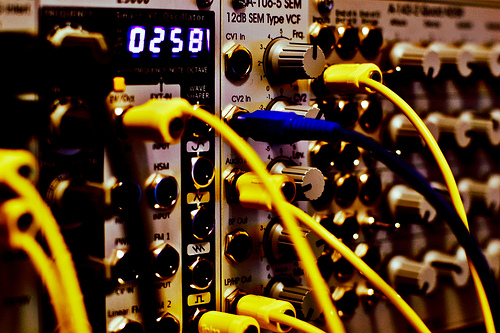
I have nothing to add to the discussion (haven't played out in years...), but howzabout you tell us a little something about that super-slutty modular pic?
Oh, heh. Decided to re-join the Modular World. Got a 6U Euro-Crack with what is, for all intents and purposes, a 1-osc monosyth. Got it more for research than musical use, though.
-CR
The strictly electronic sets I've done were all original material created explicitly for that set. Which is a big part of why I stopped doing them, it was difficult to create those sets and still have enough momentum left to write non-live music. But, that was a special case, in that I was only playing in Toronto, and the audiences for the shows were mostly the same people. Didn't seem right to repeat myself.
I've considered doing a live set in the near-ish future with just a modular, but I have some reservations. I've discovered that the most fun I've ever had just sitting down and making electronic music is with the modular, but I'm not sure yet if that would translate to good entertainment for an audience.
The one and only Micronaut tour I did, I did with a large(ish) modular, 9U of Frac Rack. The nice thing about having a bigger one is that you don't have to do much re-patching. I chose a module complement that would allow three basic sounds without patching, and worked out minor tweaks to extend that to 9-ish different sounds, which is enough for a set.
But it was just part of an overall rig that was fairly large, and I didn't use it as the sole source of sound generation. (I also had an FS1R, a Z1, and I can't recall what else, plus a guitar player on stage.) I don't think I would do a set with just a modular. I don't like single-point-source failure possibilities on stage.
To that end, every sound I'm using the TETR4 for in this set is also recreated in Massive. If the TETR4 has Issues, I can just unplug it and make the Massive channel audible, and I'm good to go. Redundancy is the name of the game. My ultimate goal is to be able to have problems in any set, and have the audience have no idea whatsoever that they occurred.
-CR
But then you can't do the angry "WTF technology?" face when something goes wrong.
"My ultimate goal is to be able to have problems in any set, and have the audience have no idea whatsoever that they occurred."
this is what Chuck Norris would do too.
i haven't played live in a long time but typically it was just a laptop and audiomulch. i'd have a starting place and press play and the set was different every time. i always did have a file or two loaded that i could route to a mixer in the patch just in case i lost my way and in the beginning i had a portable CD player ready to save the day just in case of a crash but after the first couple gigs i didn't bother because i had my patch super stable and audiomulch is a pretty rock solid beast even when it was in beta pre V 1.
when playing w/hardware it was the elektrons or w/a group of friends who each had a drum machine/synth/sampler of some kind so we each just kind of flowed in and out of the set w/our various parts... no planning other than making sure our machines were sync'd.
i always hated the idea of recreating songs for a live set. i just couldn't bring myself to make a bunch of loops out of things and throw them in live. i my do something like that one day if i ever get the motivation to play live again but i'd rather just make up a bunch of new stuff for a live set.. i think it might be easier.. just a bunch of new parts that i can bring together but don't really have to have a beginning middle end
welcome back
"Much easier for an indie rock band to change things up on a whim than a strictly electronic project, I imagine."
Really? I've never been in an indie rock band, but I'm pretty sure it's tough to spontaneously decide on a tempo change or skip to the last breakdown or change the hi-hat pattern or whatever. Whereas those things are basically cake with a good sequencer (Live, MP-7, Electribe, whatever). Maybe you meant setlist? I still think that's easy for live electronic acts. My point here is that improvising rules.
Fugazi turned all their shows into a game of sorts.
No sets ever.
The band would collectively choose a starting song for the night and play that song. When it was finished, one member would choose another song and begin to play it. No warning to the other members. Then the others would figure out what that song was and immediately join in.
Once that song was done, another member would do the same thing. It kept revolving from Guy to Ian to Joe to Brendan and back to Guy.
With a catalogue of probably a hundred songs to choose from, this method kept the band on its toes. And, though the audience was largely unaware of the technique, I think it helped the shows feel electric and tighrope-ish.
Fugazi were all about rock'n'roll daring and this is an extreme version of set spontaneity, unless you maybe include totally free improvised music.
I don't know much about Ableton Live --- I am a moron --- but isn't that one of the things it is supposed to implicitly encourage/facillitate? More improv/freedom/spontaneity within electronic music?
- c
i love fugazi and wish they'd make another record. i miss them. amazing live shows too.
that is all.
@Chris
My synth repair guy, who's about your age, makes the same association regarding the cars and osc sync, he mods MG-1s with sync sweep switches labelled "The Cars" https://www.flickr.com/photos/31603983 @N05/4466275044/in/set-72157623699044450/
Why not just create an entirely new batch of material for the live set? That was you can fine tine every nuance with total disregard to restrictions imposed by previous work. I did that recently where, in response to a last minute invitation to perform, I spent a couple afternoons crafting a set to fill my time slot. Then, once everything was more or less in place (not to mention blissfully underproduced), I lined up a few virtual synths in the session to compliment the arrangements, which allowed me to get some of my improvisational yayas out. I had a blast, and the challenge of composing a cohesive 45 minute opus was a welcome one indeed.
I've done that a few times, but I don't find it creatively satisfying, because the results are (at best) half finished. I'm a producer, and thus get the most satisfaction from production.
Don't get me wrong: there is a metric shit-ton of improvisation in my sets, and the way I have it set up, it's essentially impossible to play the same set twice. But I need some structure so that I don't have to be hunched over the laptop the whole show wondering wtf I'm going to do next. I find shows like this to be terribly un-entertaining, both as a performer and as an audience member.
-CR
I'm with boobs.
Comments are closed on this post.